library(stochtree)Posterior Summary and Visualization Utilities
This vignette demonstrates the summary and plotting utilities available for stochtree models.
Setup
Load necessary packages
import numpy as np
import matplotlib.pyplot as plt
from stochtree import BARTModel, BCFModel, plot_parameter_trace
Set a seed for reproducibility
random_seed = 1234
set.seed(random_seed)
random_seed = 1234
rng = np.random.default_rng(random_seed)Supervised Learning
We begin with the supervised learning use case served by the bart() function.
Below we simulate a simple regression dataset.
n <- 1000
p_x <- 10
p_w <- 1
X <- matrix(runif(n * p_x), ncol = p_x)
W <- matrix(runif(n * p_w), ncol = p_w)
f_XW <- (((0 <= X[, 10]) & (0.25 > X[, 10])) *
  (-7.5 * W[, 1]) +
  ((0.25 <= X[, 10]) & (0.5 > X[, 10])) * (-2.5 * W[, 1]) +
  ((0.5 <= X[, 10]) & (0.75 > X[, 10])) * (2.5 * W[, 1]) +
  ((0.75 <= X[, 10]) & (1 > X[, 10])) * (7.5 * W[, 1]))
noise_sd <- 1
y <- f_XW + rnorm(n, 0, 1) * noise_sd
n = 1000
p_x = 10
p_w = 1
X = rng.uniform(size=(n, p_x))
W = rng.uniform(size=(n, p_w))
# R uses X[,10] (1-indexed) = Python X[:,9]
f_XW = (
((X[:, 9] >= 0) & (X[:, 9] < 0.25)) * (-7.5 * W[:, 0]) +
((X[:, 9] >= 0.25) & (X[:, 9] < 0.5)) * (-2.5 * W[:, 0]) +
((X[:, 9] >= 0.5) & (X[:, 9] < 0.75)) * ( 2.5 * W[:, 0]) +
((X[:, 9] >= 0.75) & (X[:, 9] < 1.0)) * ( 7.5 * W[:, 0])
)
noise_sd = 1.0
y = f_XW + rng.standard_normal(n) * noise_sdNow we fit a simple BART model to the data.
num_gfr <- 10
num_burnin <- 0
num_mcmc <- 1000
general_params <- list(
  num_threads = 1,
  num_chains = 3
)
bart_model <- stochtree::bart(
  X_train = X,
  y_train = y,
  leaf_basis_train = W,
  num_gfr = num_gfr,
  num_burnin = num_burnin,
  num_mcmc = num_mcmc,
  general_params = general_params
)
bart_model = BARTModel()
bart_model.sample(
X_train=X,
y_train=y,
leaf_basis_train=W,
num_gfr=10,
num_burnin=0,
num_mcmc=1000,
general_params={
"num_threads": 1,
"num_chains": 3
},
)We obtain a high level summary of the BART model by running print().
print(bart_model)stochtree::bart() run with mean forest, global error variance model, and mean forest leaf scale model
Continuous outcome was modeled as Gaussian with a leaf regression prior with 1 bases for the mean forest
Outcome was standardized
The sampler was run for 10 GFR iterations, with 3 chains of 0 burn-in iterations and 1000 MCMC iterations, retaining every iteration (i.e. no thinning) print(bart_model)BARTModel run with mean forest, global error variance model, and mean forest leaf scale model
Outcome was modeled as gaussian with a leaf regression prior with 1 bases for the mean forest
Outcome was standardized
The sampler was run for 10 GFR iterations, with 3 chains of 0 burn-in iterations and 1000 MCMC iterations, retaining every iteration (i.e. no thinning)For a more detailed summary (including the information above), we use the summary() function.
summary(bart_model)stochtree::bart() run with mean forest, global error variance model, and mean forest leaf scale model
Continuous outcome was modeled as Gaussian with a leaf regression prior with 1 bases for the mean forest
Outcome was standardized
The sampler was run for 10 GFR iterations, with 3 chains of 0 burn-in iterations and 1000 MCMC iterations, retaining every iteration (i.e. no thinning)
Summary of sigma^2 posterior:
3000 samples, mean = 0.901, standard deviation = 0.049, quantiles:
2.5% 10% 25% 50% 75% 90% 97.5%
0.8084714 0.8388306 0.8680266 0.8992727 0.9336765 0.9648054 1.0010869
Summary of leaf scale posterior:
3000 samples, mean = 0.007, standard deviation = 0.001, quantiles:
2.5% 10% 25% 50% 75% 90%
0.004911442 0.005389620 0.005886887 0.006525353 0.007247687 0.008185487
97.5%
0.010413552
Summary of in-sample posterior mean predictions:
1000 observations, mean = -0.063, standard deviation = 3.282, quantiles:
2.5% 10% 25% 50% 75% 90% 97.5%
-6.8314536 -4.9405243 -1.8349978 -0.1206575 2.0277810 4.2518488 6.4819357 print(bart_model.summary())BART Model Summary:
-------------------
BARTModel run with mean forest, global error variance model, and mean forest leaf scale model
Outcome was modeled as gaussian with a leaf regression prior with 1 bases for the mean forest
Outcome was standardized
The sampler was run for 10 GFR iterations, with 3 chains of 0 burn-in iterations and 1000 MCMC iterations, retaining every iteration (i.e. no thinning)
Summary of sigma^2 posterior: 3000 samples, mean = 0.937, standard deviation = 0.048, quantiles:
2.5%: 0.845
10.0%: 0.875
25.0%: 0.904
50.0%: 0.936
75.0%: 0.968
90.0%: 0.998
97.5%: 1.037
Summary of leaf scale posterior: 3000 samples, mean = 0.007, standard deviation = 0.001, quantiles:
2.5%: 0.005
10.0%: 0.005
25.0%: 0.006
50.0%: 0.007
75.0%: 0.008
90.0%: 0.009
97.5%: 0.010
Summary of in-sample posterior mean predictions:
1000 observations, mean = 0.106, standard deviation = 3.287, quantiles:
2.5%: -6.695
10.0%: -4.333
25.0%: -1.950
50.0%: 0.170
75.0%: 2.097
90.0%: 4.438
97.5%: 6.588
NoneWe can use the plot() function to produce a traceplot of model terms like the global error scale \(\sigma^2\) or (if \(\sigma^2\) is not sampled) the first observation of cached train set predictions.
plot(bart_model)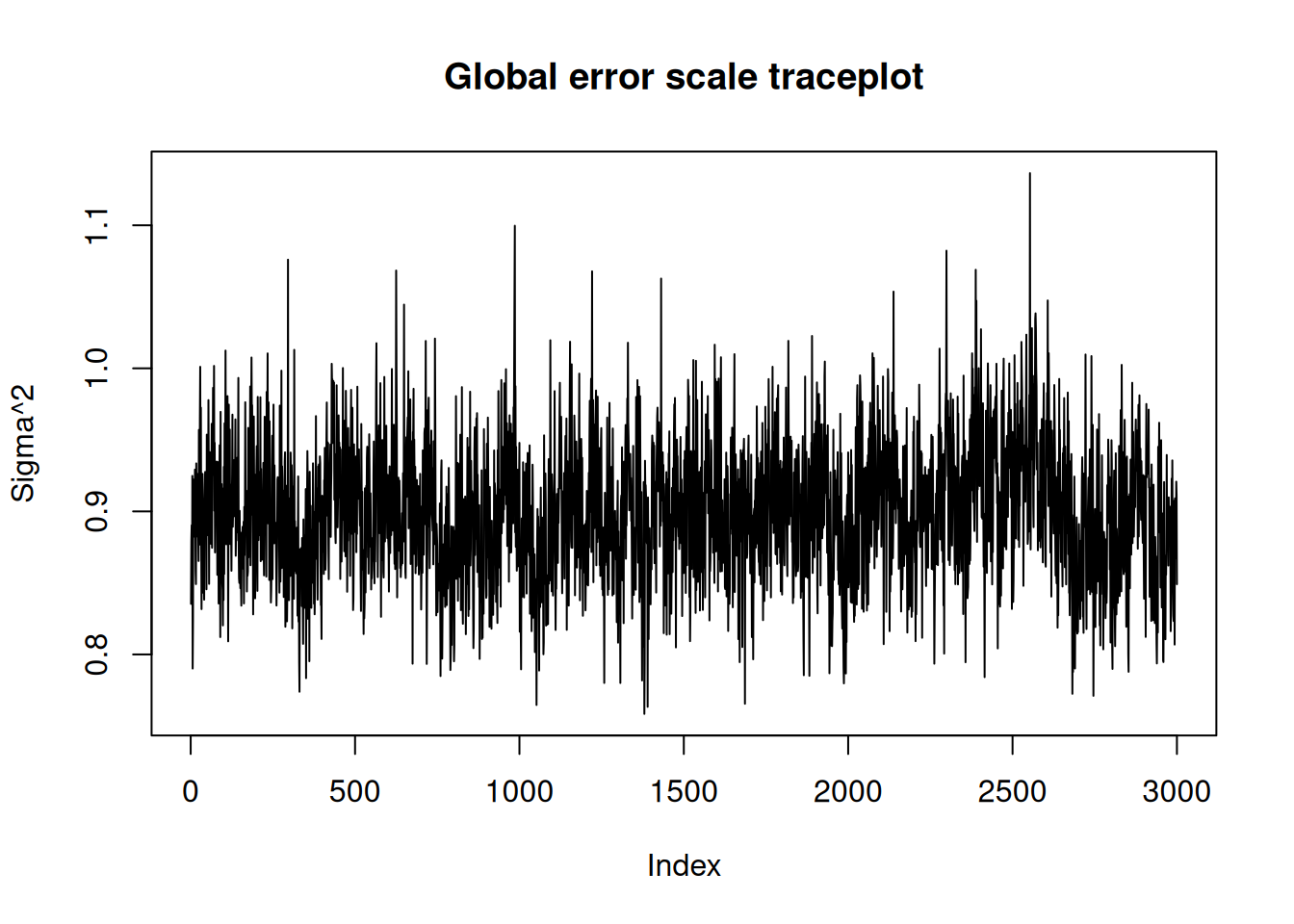
ax = plot_parameter_trace(bart_model, term="global_error_scale")
plt.show()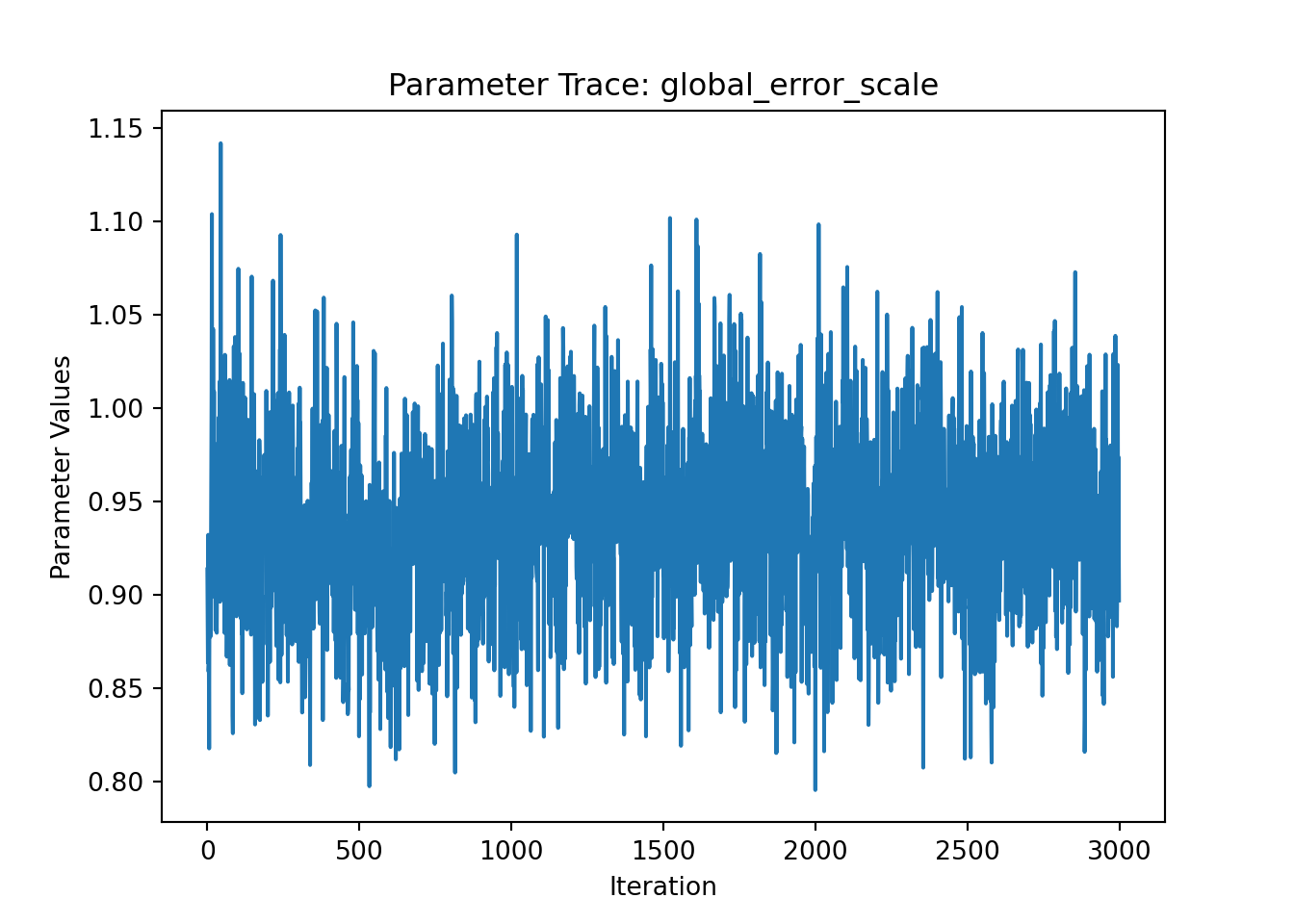
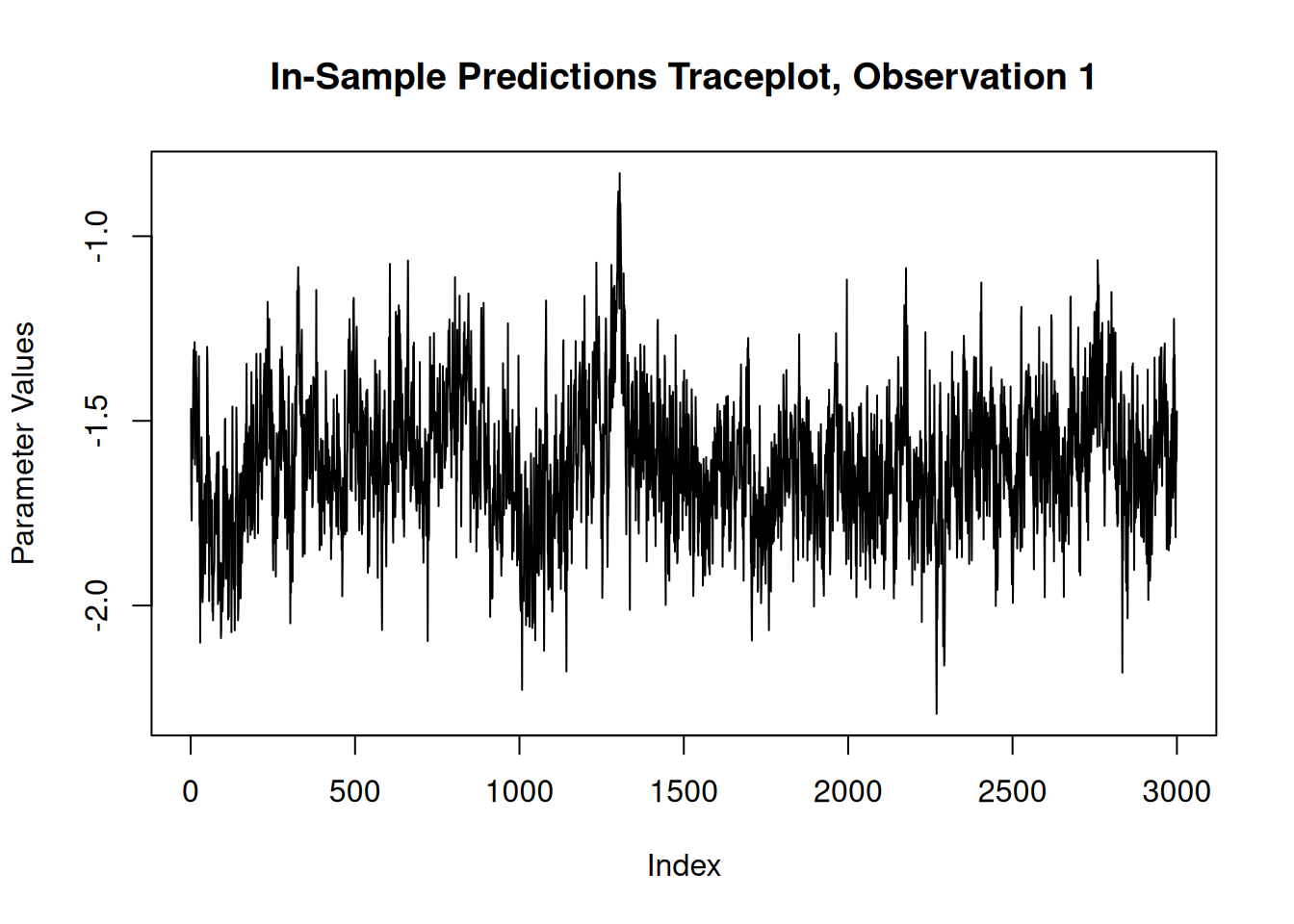
For finer-grained control over which parameters to plot, we can also use the extractParameter() function to pull the posterior distribution of any valid model term (e.g., global error scale \(\sigma^2\), leaf scale \(\sigma^2_{\ell}\), in-sample mean function predictions y_hat_train) and then plot any subset or transformation of these values.
y_hat_train_samples <- extractParameter(bart_model, "y_hat_train")
obs_index <- 1
plot(
  y_hat_train_samples[obs_index, ],
  type = "l",
  main = paste0("In-Sample Predictions Traceplot, Observation ", obs_index),
  xlab = "Index",
  ylab = "Parameter Values"
)
y_hat_train_samples = bart_model.extract_parameter("y_hat_train")
obs_index = 0
fig, ax = plt.subplots()
ax.plot(y_hat_train_samples[obs_index, :])
ax.set_title(f"In-Sample Predictions Traceplot, Observation {obs_index}")
ax.set_xlabel("Index")
ax.set_ylabel("Parameter Values")
plt.show()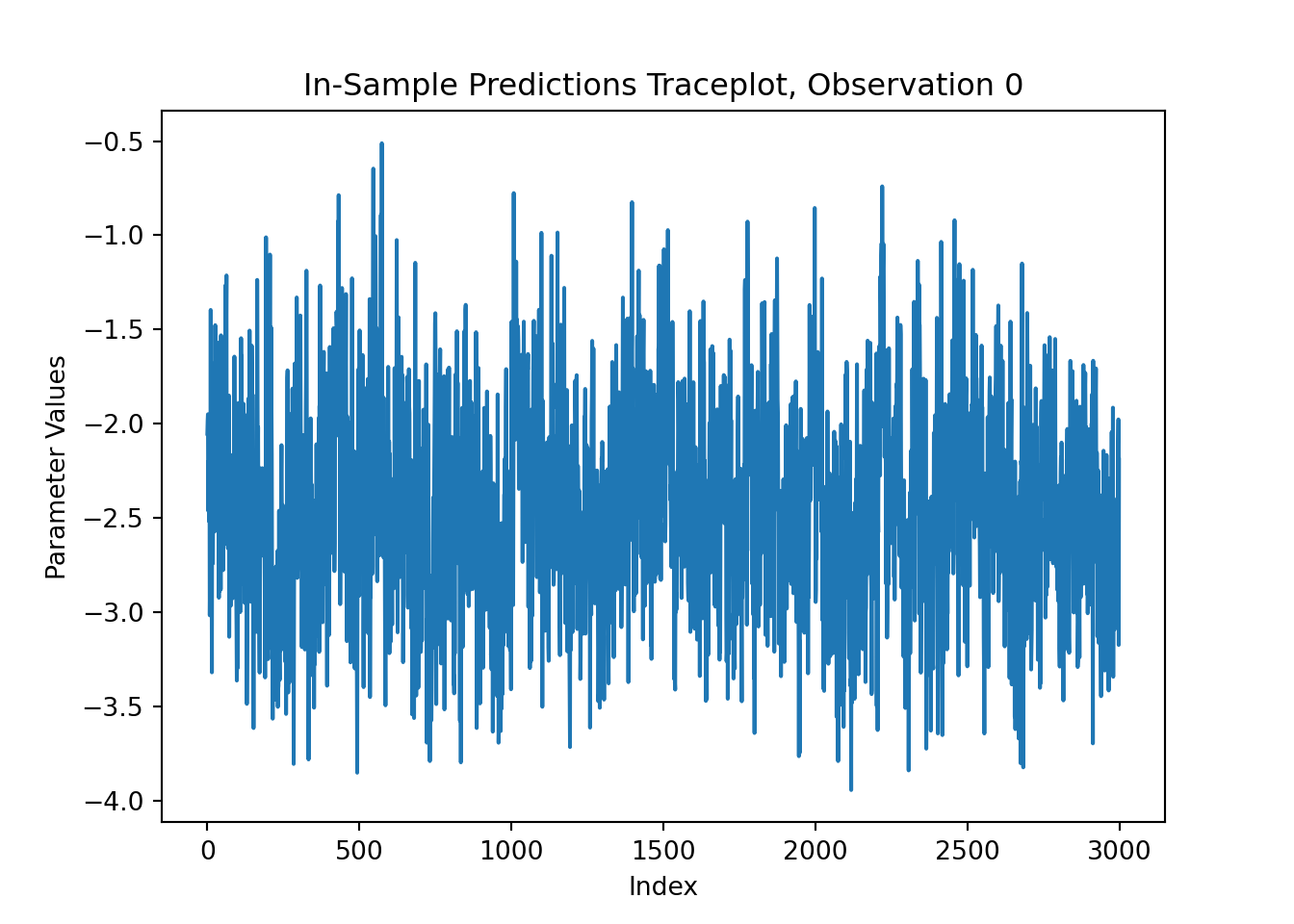
Causal Inference
We now run the same demo for the causal inference use case served by the bcf() function in R and the BCFModel Python class.
Below we simulate a simple dataset for a causal inference problem with binary treatment and continuous outcome.
# Generate covariates and treatment
n <- 1000
p_X = 5
X = matrix(runif(n * p_X), ncol = p_X)
pi_X = 0.25 + 0.5 * X[, 1]
Z = rbinom(n, 1, pi_X)

# Define the outcome mean functions (prognostic and treatment effects)
mu_X = pi_X * 5 + 2 * X[, 3]
tau_X = X[, 2] * 2 - 1

# Generate outcome
epsilon = rnorm(n, 0, 1)
y = mu_X + tau_X * Z + epsilon
# Generate covariates and treatment
n = 1000
p_X = 5
X = rng.uniform(size=(n, p_X))
pi_X = 0.25 + 0.5 * X[:, 0]
Z = rng.binomial(1, pi_X, n).astype(float)
# Define the outcome mean functions (prognostic and treatment effects)
mu_X = pi_X * 5 + 2 * X[:, 2]
tau_X = X[:, 1] * 2 - 1
# Generate outcome
epsilon = rng.standard_normal(n)
y = mu_X + tau_X * Z + epsilonNow we fit a simple BCF model to the data
num_gfr <- 10
num_burnin <- 0
num_mcmc <- 1000
general_params <- list(
  num_threads = 1,
  num_chains = 3,
  adaptive_coding = TRUE
)
bcf_model <- stochtree::bcf(
  X_train = X,
  y_train = y,
  Z_train = Z,
  num_gfr = num_gfr,
  num_burnin = num_burnin,
  num_mcmc = num_mcmc,
  general_params = general_params
)
bcf_model = BCFModel()
bcf_model.sample(
X_train=X,
Z_train=Z,
y_train=y,
propensity_train=pi_X,
num_gfr=10,
num_burnin=0,
num_mcmc=1000,
general_params={
"num_threads": 1,
"num_chains": 3,
"adaptive_coding": True
},
)We obtain a high level summary of the BCF model by running print().
print(bcf_model)stochtree::bcf() run with prognostic forest, treatment effect forest, global error variance model, prognostic forest leaf scale model, and treatment effect intercept model
Outcome was modeled as gaussian
Treatment was binary and its effect was estimated with adaptive coding
outcome was standardized
An internal propensity model was fit using stochtree::bart() in lieu of user-provided propensity scores
The sampler was run for 10 GFR iterations, with 3 chains of 0 burn-in iterations and 1000 MCMC iterations, retaining every iteration (i.e. no thinning) print(bcf_model)BCFModel run with prognostic forest, treatment effect forest, global error variance model, prognostic forest leaf scale model, and treatment effect intercept model
Outcome was modeled as gaussian
Treatment was binary and its effect was estimated with adaptive coding
Outcome was standardized
User-provided propensity scores were included in the model
The sampler was run for 10 GFR iterations, with 3 chains of 0 burn-in iterations and 1000 MCMC iterations, retaining every iteration (i.e. no thinning)For a more detailed summary (including the information above), we use the summary() function / method.
summary(bcf_model)stochtree::bcf() run with prognostic forest, treatment effect forest, global error variance model, prognostic forest leaf scale model, and treatment effect intercept model
Outcome was modeled as gaussian
Treatment was binary and its effect was estimated with adaptive coding
outcome was standardized
An internal propensity model was fit using stochtree::bart() in lieu of user-provided propensity scores
The sampler was run for 10 GFR iterations, with 3 chains of 0 burn-in iterations and 1000 MCMC iterations, retaining every iteration (i.e. no thinning)
Summary of sigma^2 posterior:
3000 samples, mean = 0.946, standard deviation = 0.045, quantiles:
2.5% 10% 25% 50% 75% 90% 97.5%
0.8645020 0.8892012 0.9140724 0.9449293 0.9764466 1.0034052 1.0375886
Summary of prognostic forest leaf scale posterior:
3000 samples, mean = 0.002, standard deviation = 0.000, quantiles:
2.5% 10% 25% 50% 75% 90%
0.001057296 0.001209163 0.001370317 0.001610125 0.001873949 0.002159361
97.5%
0.002546179
Summary of adaptive coding parameters:
3000 samples, mean (control) = -0.505, mean (treated) = 0.981, standard deviation (control) = 0.361, standard deviation (treated) = 0.333
quantiles (control):
2.5% 10% 25% 50% 75% 90%
-1.23911357 -0.98048729 -0.73755217 -0.49107766 -0.25404127 -0.06213661
97.5%
0.14085744
quantiles (treated):
2.5% 10% 25% 50% 75% 90% 97.5%
0.3855154 0.5659824 0.7457181 0.9574154 1.2146875 1.4170520 1.6604263
Summary of treatment effect intercept (tau_0) posterior:
3000 samples, mean = 0.209, standard deviation = 0.763, quantiles:
2.5% 10% 25% 50% 75% 90% 97.5%
-1.2409068 -0.8191327 -0.3453519 0.1324100 0.8273019 1.2135280 1.5785539
Summary of in-sample posterior mean predictions:
1000 observations, mean = 3.487, standard deviation = 0.945, quantiles:
2.5% 10% 25% 50% 75% 90% 97.5%
1.652765 2.284171 2.804965 3.480427 4.158614 4.715312 5.420427
Summary of in-sample posterior mean CATEs:
1000 observations, mean = 0.082, standard deviation = 0.520, quantiles:
2.5% 10% 25% 50% 75% 90%
-0.714820155 -0.547859437 -0.377733306 0.001793595 0.583845332 0.794696856
97.5%
0.917897574 print(bcf_model.summary())BCF Model Summary:
------------------
BCFModel run with prognostic forest, treatment effect forest, global error variance model, prognostic forest leaf scale model, and treatment effect intercept model
Outcome was modeled as gaussian
Treatment was binary and its effect was estimated with adaptive coding
Outcome was standardized
User-provided propensity scores were included in the model
The sampler was run for 10 GFR iterations, with 3 chains of 0 burn-in iterations and 1000 MCMC iterations, retaining every iteration (i.e. no thinning)
Summary of sigma^2 posterior: 3000 samples, mean = 0.872, standard deviation = 0.041, quantiles:
2.5%: 0.795
10.0%: 0.820
25.0%: 0.844
50.0%: 0.871
75.0%: 0.900
90.0%: 0.925
97.5%: 0.958
Summary of prognostic forest leaf scale posterior: 3000 samples, mean = 0.002, standard deviation = 0.000, quantiles:
2.5%: 0.001
10.0%: 0.001
25.0%: 0.002
50.0%: 0.002
75.0%: 0.002
90.0%: 0.002
97.5%: 0.003
Summary of adaptive coding parameters:
3000 samples, mean (control) = -0.557, mean (treated) = 1.100, standard deviation (control) = 0.355, standard deviation (treated) = 0.348
quantiles (control):
2.5%: -1.288
10.0%: -1.008
25.0%: -0.797
50.0%: -0.548
75.0%: -0.303
90.0%: -0.101
97.5%: 0.080
quantiles (treated):
2.5%: 0.454
10.0%: 0.645
25.0%: 0.854
50.0%: 1.095
75.0%: 1.343
90.0%: 1.542
97.5%: 1.806
Summary of treatment effect intercept (tau_0) posterior: 3000 samples, mean = 0.027, standard deviation = 0.383, quantiles:
2.5%: -0.662
10.0%: -0.483
25.0%: -0.253
50.0%: 0.021
75.0%: 0.295
90.0%: 0.564
97.5%: 0.749
Summary of in-sample posterior mean predictions:
1000 observations, mean = 3.482, standard deviation = 0.962, quantiles:
2.5%: 1.843
10.0%: 2.205
25.0%: 2.771
50.0%: 3.470
75.0%: 4.160
90.0%: 4.758
97.5%: 5.329
Summary of in-sample posterior mean CATEs:
1000 observations, mean = -0.028, standard deviation = 0.626, quantiles:
2.5%: -1.079
10.0%: -0.915
25.0%: -0.575
50.0%: 0.053
75.0%: 0.543
90.0%: 0.747
97.5%: 0.922
NoneIn R, we have a plot() that produces a traceplot of model terms like the global error scale \(\sigma^2\) or (if \(\sigma^2\) is not sampled) the first observation of cached train set predictions.
In Python, we provide a plot_parameter_trace() function for requesting a traceplot of a specific model parameter.
plot(bcf_model)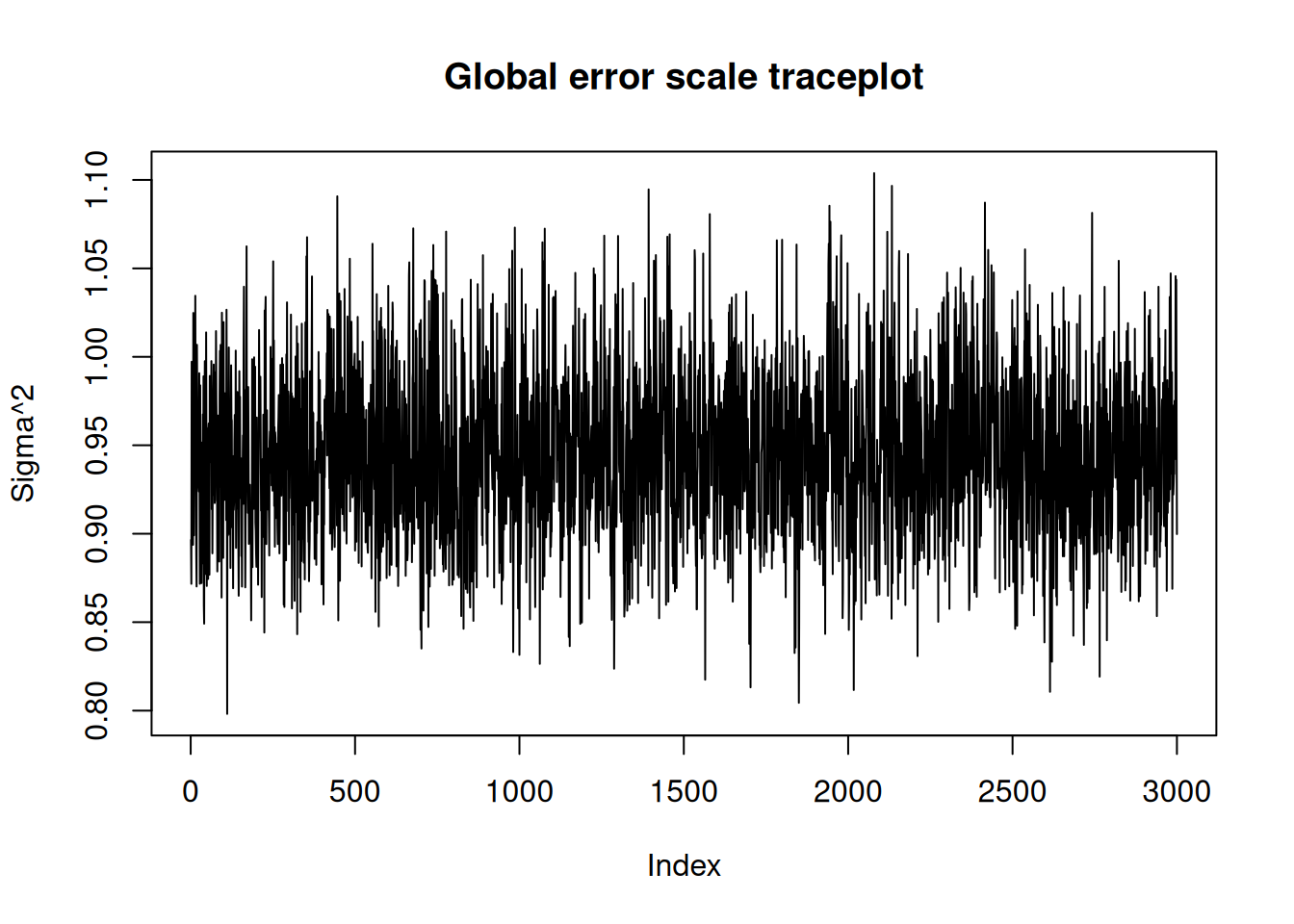
ax = plot_parameter_trace(bcf_model, term="global_error_scale")
plt.show()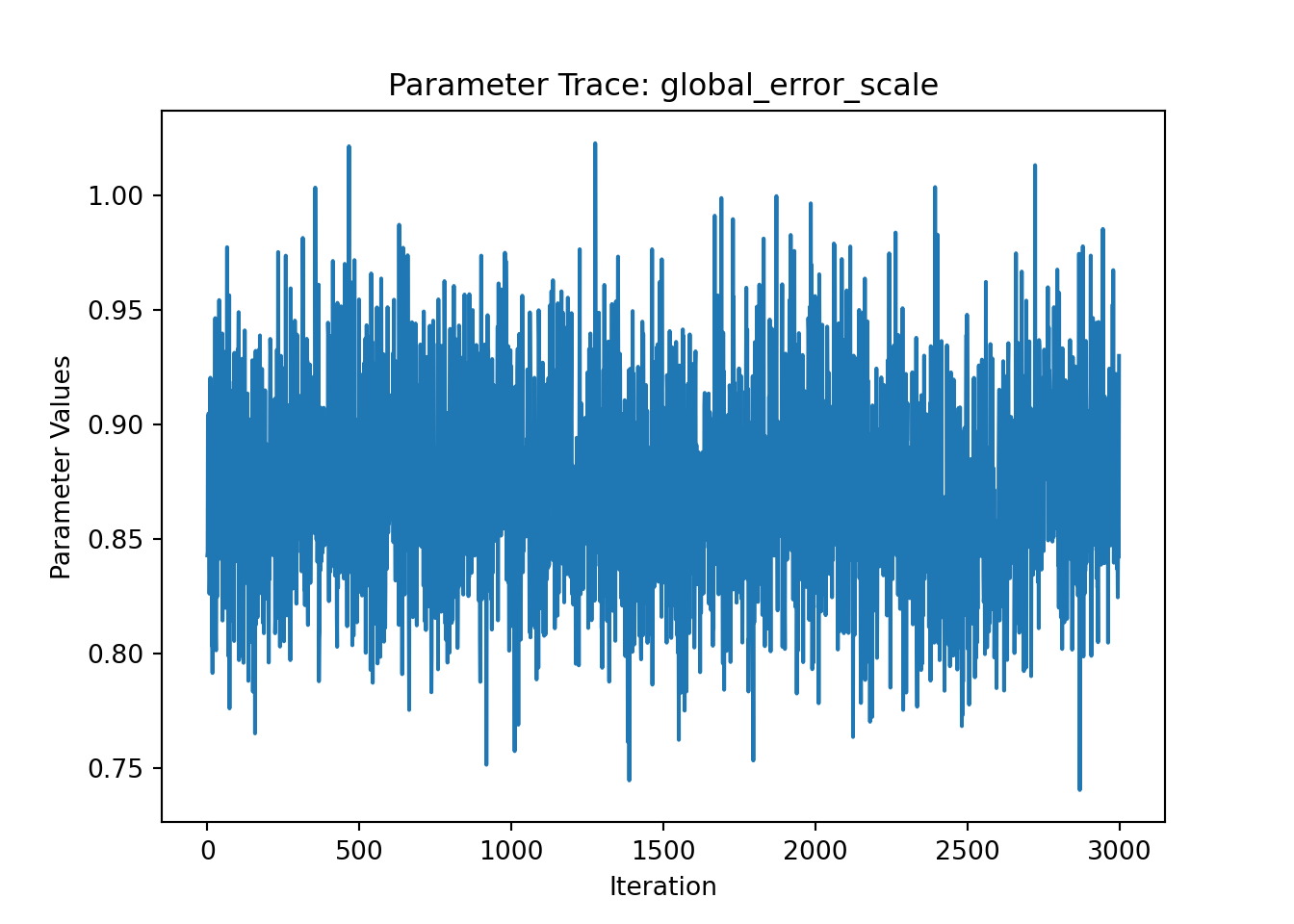
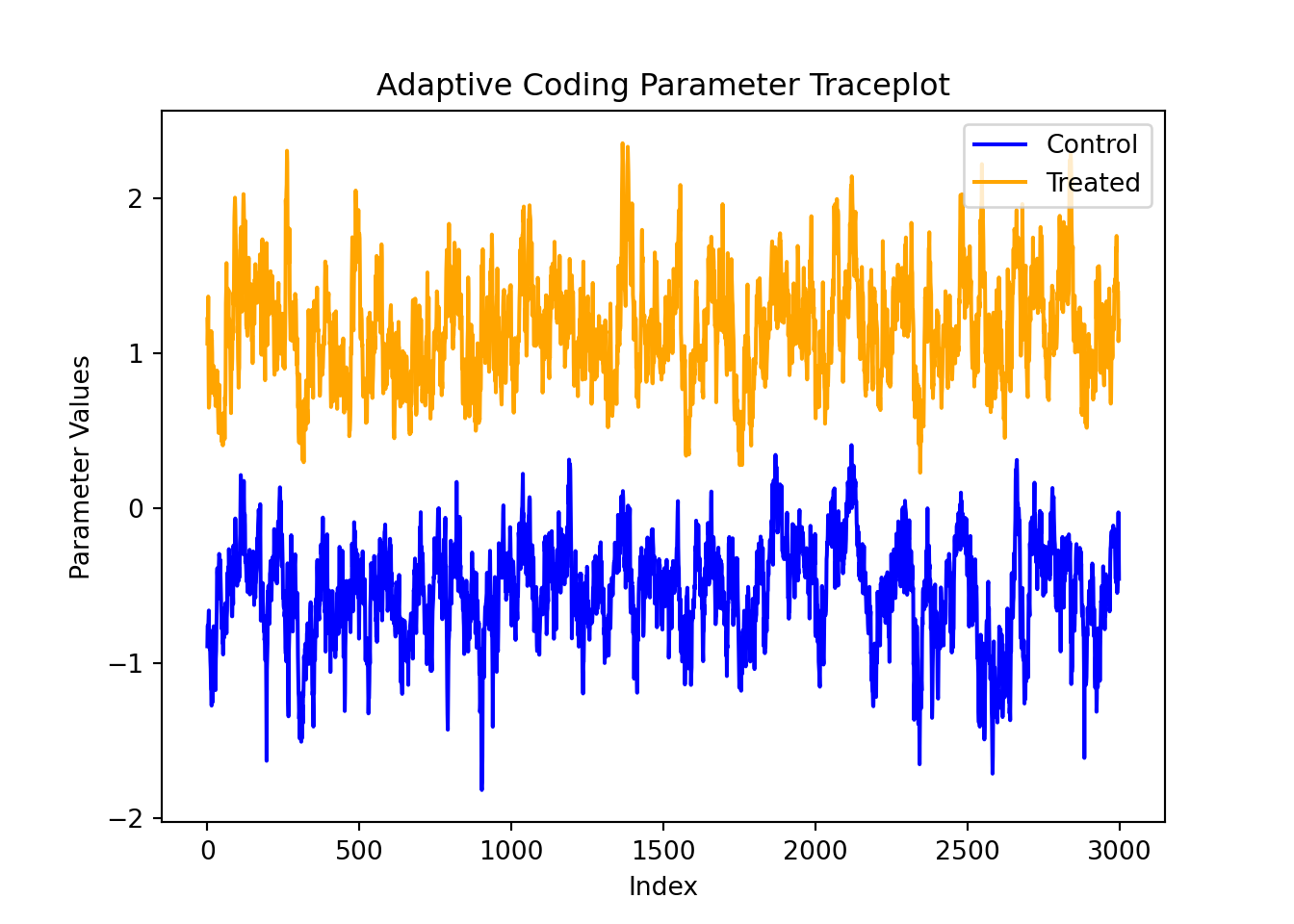
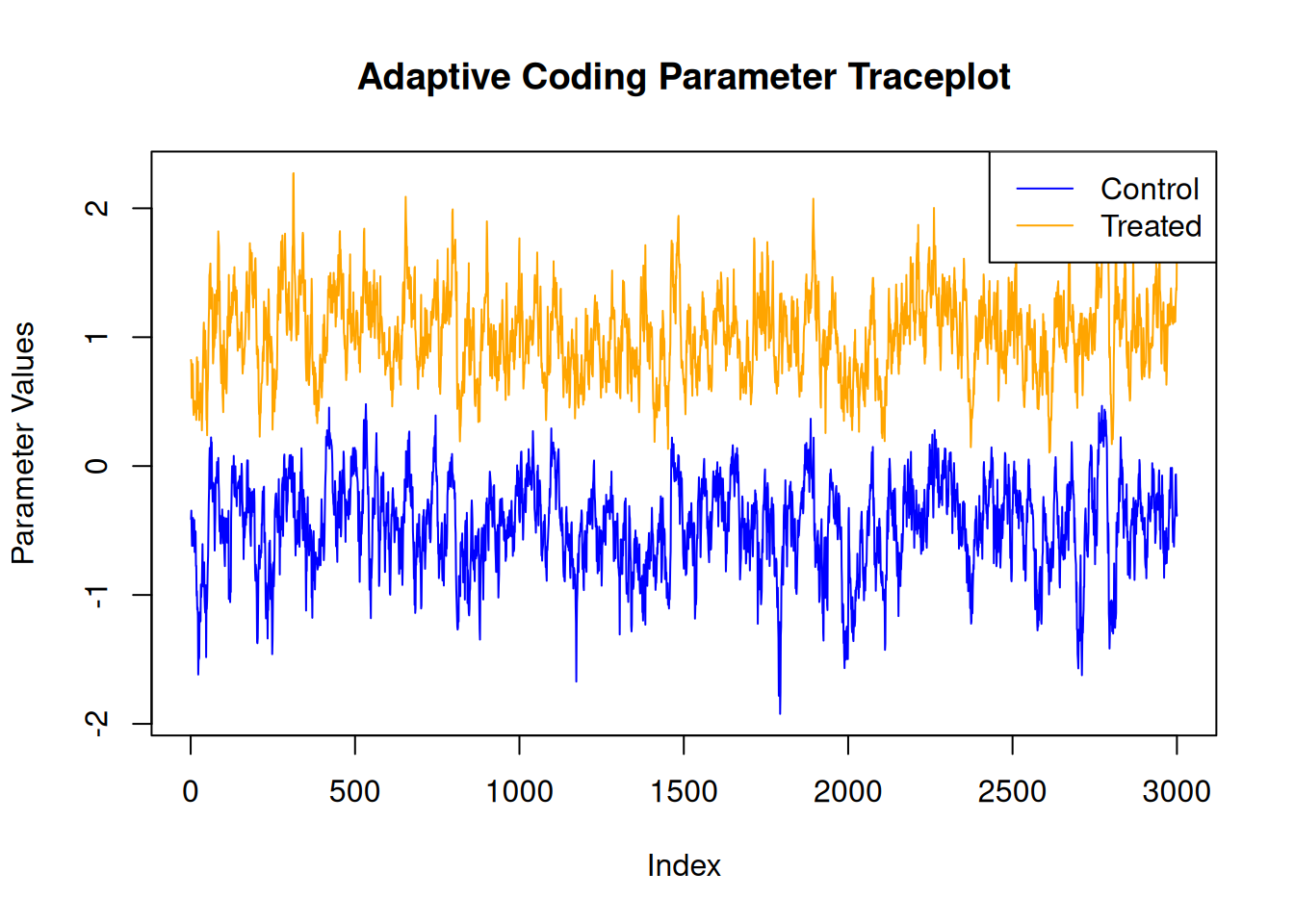
For finer-grained control over which parameters to plot, we can also use the extractParameter() function in R or the extract_parameter() method in Python to query the posterior distribution of any valid model term (e.g., global error scale \(\sigma^2\), prognostic forest leaf scale \(\sigma^2_{\mu}\), CATE forest leaf scale \(\sigma^2_{\tau}\), adaptive coding parameters \(b_0\) and \(b_1\) for binary treatment, in-sample mean function predictions y_hat_train, in-sample CATE function predictions tau_hat_train) and then plot any subset or transformation of these values.
adaptive_coding_samples <- extractParameter(bcf_model, "adaptive_coding")
plot(
  adaptive_coding_samples[1, ],
  type = "l",
  main = "Adaptive Coding Parameter Traceplot",
  xlab = "Index",
  ylab = "Parameter Values",
  ylim = range(adaptive_coding_samples),
  col = "blue"
)
lines(adaptive_coding_samples[2, ], col = "orange")
legend(
  "topright",
  legend = c("Control", "Treated"),
  lty = 1,
  col = c("blue", "orange")
)
adaptive_coding_samples = bcf_model.extract_parameter("adaptive_coding")
fig, ax = plt.subplots()
ax.plot(adaptive_coding_samples[0, :], color="blue", label="Control")
ax.plot(adaptive_coding_samples[1, :], color="orange", label="Treated")
ax.set_title("Adaptive Coding Parameter Traceplot")
ax.set_xlabel("Index")
ax.set_ylabel("Parameter Values")
ax.legend(loc="upper right")
plt.show()